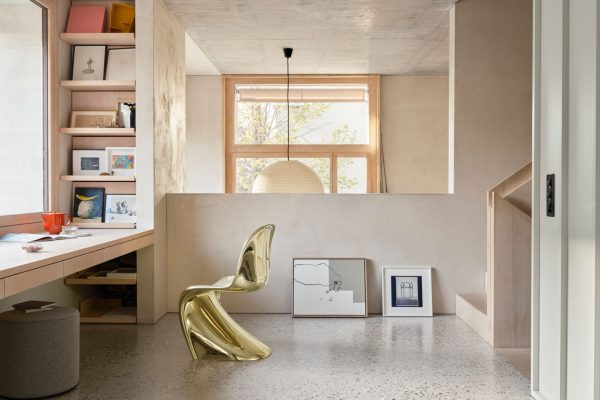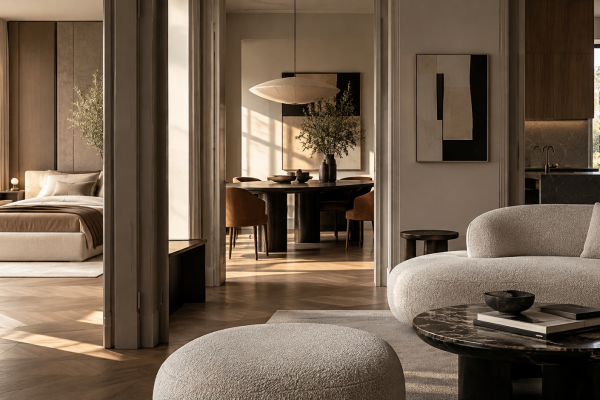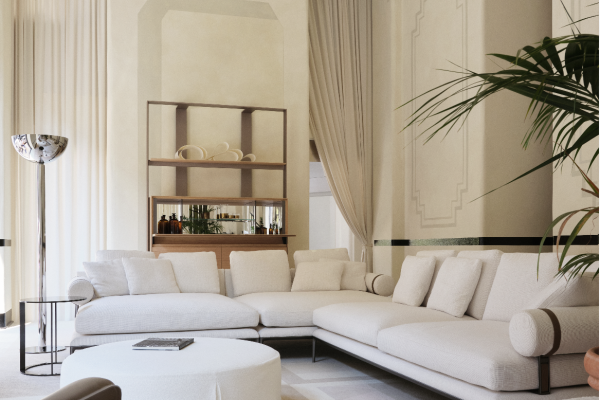
Essentiality as Design Quality
Essentiality is one of the most relevant themes in contemporary design today, yet it is often misunderstood.
Being essential does not mean reducing or impoverishing a space. It means eliminating what does not genuinely contribute to the quality of the living experience.
Contemporary interiors are not being emptied; they are being clarified.
Design increasingly focuses on the precision of choices, the coherence of materials and the creation of spaces capable of maintaining balance over time.
Project-oriented realities such as SAG’80 interpret this evolution through a design approach that prioritises perceptual quality, continuity and restraint.
From Accumulation to Selection
This is the key point often missing from the conversation.
In recent years, design has progressively moved away from the logic of accumulation.
More materials.
More finishes.
More objects.
More stimuli.
Today, value lies in selection.
Every element must justify its presence within a space.
Contemporary essentiality emerges precisely from this process of critical selection, where function, aesthetics and perception are constantly evaluated in relation to one another.
This is one of the most evident shifts that also emerged in the projects presented during the latest Milan Design Week.
Visual Continuity and Spatial Fluidity
Visual continuity is not merely an aesthetic criterion.
It also allows designers to:
- enhance the perception of space
- improve the readability of interiors
- reduce visual noise
- create a stronger sense of balance
For this reason, materials, surfaces and integrated systems are playing an increasingly central role in contemporary design.
The Quality of Invisible Details
Invisible details are among the clearest indicators of design quality.
Concealed hinges, integrated lighting, minimised profiles and hidden technical systems allow spaces to appear natural and free from visual interference.
The goal is not to impress, but to simplify the experience of living within the space.
It is precisely this apparent simplicity that requires the highest level of design expertise and coordination.
Why Essential Spaces Improve Well-Being
This is the aspect that makes the discussion particularly relevant today.
The growing pursuit of essentiality is not merely an aesthetic choice.
It is closely linked to well-being.
Less fragmented and more coherent environments:
- encourage concentration
- reduce visual overload
- improve perceptual quality
- make spaces more intuitive to inhabit
Contemporary essentiality is therefore not a trend, but a concrete response to new ways of living and using domestic space.
Conclusion
Contemporary interiors are evolving toward a more mature and conscious form of essentiality.
It is not about reducing; it is about choosing better.
Materials, light, details and proportions are used to create spaces that are more fluid, more legible and more enduring.
For project-oriented realities such as SAG’80, this means guiding clients and designers in the creation of environments that do not pursue complexity, but rather the quality of the living experience.
FAQ
What does essential design mean in contemporary interiors?
It means creating spaces where every element serves a clear purpose and contributes to the overall quality of the environment.
Does essential mean minimalist?
Not necessarily. Contemporary essentiality is about the quality of design selection rather than the extreme reduction of elements.
Why do essential spaces improve well-being?
Because they reduce visual noise, improve the readability of interiors and foster a more balanced perception of space.